

She Works Out What Chair She'll Be Sitting On Before She Works Out What She'll Say
Style & Strategy: The Leadership Series. Conversations with women in leadership on how they got there, what it took, and the part their personal style played along the way.

I had the privilege of interviewing a Chief Product and Operating Officer for a listed technology company a couple of years ago. Part of that conversation we were speaking about her style and the one thing she always look out for. She said, before she speaks at an event, she works out what kind of chair she will be sitting on.

Whether the seat is low or high, whether it swivels, whether she will be angled towards an audience or towards a panel, and what all of that means for the hem, the shoes, and whether she can stop thinking about any of it once she starts talking. Her own words for how much time this takes her: an inordinate amount.
She said it as a matter of fact, no complaints, because to her it is simply part of the job.
The people beside her on that panel are working out what they will say. She is working out what she will say AND running a second calculation underneath it, and that second calculation has its own rules. Her summary of them, verbatim: you cannot be too frumpy, you cannot be too dowdy, you cannot be too sexy, you cannot be this, you cannot be that.
Read those rules together and they cancel each other out. There is no outfit that satisfies all of them at once, which is the tell. She is not failing a standard, she is being scored against notes that contradict themselves, and every adjustment she makes for one of them triggers the opposite one.
Then she said the thing I have not been able to put down.
“It annoys me, but I also know that that’s just the ticket to play.”
The second calculation nobody costs out
That is a more accurate read of the room than most leadership advice will give you.
She is not pretending the calculation isn’t running, and she has not built an identity out of resenting it either, which is the more common option and by far the more expensive one. She has priced it, decided it is the cost of entry at her level, and put her attention back on the thing she actually came to do.
Leadership costs energy, especially juggling or should I say holding it at that level. Running a second calculation underneath every room costs extra. Those are two different expenses and only one of them ever comes up in a workload conversation. Nobody puts a line through the budget for the woman who arrived at the investor briefing having already solved the chair, the lighting, the hem and the shoes before she got anywhere near the numbers.
What interests me about this conversation was that it was not that she runs the calculation, because most women operating at her level are running a version of it. What interests me is how much of the recurring cost she has managed to take out of it.
Fifteen years of the corporate dress, one piece and one decision, with a neckline that works in a boardroom and still works when the day runs from the desk through to hosting clients at dinner. Hair air-dried. A face she can do in five minutes, because she trained as a makeup artist at nineteen and never stopped. On television she wears block colours so the audience stays with her and not with what she has on, and she reaches for bottle greens and navy blues rather than black. When she wants a piece to carry some weight of its own she goes to leather, cut sharp and paired back against a white collar.
She called that being lazy, which it plainly is not, because what she has done is answer a set of questions once so that they stop asking themselves every morning. That is a different thing entirely, and it is the only version of this I have seen hold across a twenty-year executive career.
The room did not have a settled answer either
Two weeks before she started at a new role in a technology firm, she rang her incoming boss and asked what she should wear. She prefaced it by calling it a really silly question.
He did not treat it as one. He had come across from finance himself six months earlier and had sat with exactly the same question, and he understood, as she put it, that the question was considerably harder for her than it had been for him.
It was not a silly question, because the organisation genuinely did not have a settled answer. Call it Smart Casual, Business Casual. There are teams and teams of engineers in t-shirts, jeans and runners, while some of the biggest clients are banks and broking firms who back then were considerably more conservative than anyone in the building, and the executive floor has to work for both at once.
So the corporate dresses came out of daily rotation and now come out for client meetings. Her ordinary day is something longer and more contemporary worn with runners, denim and chambray as the weather turns, and a pair of sparkly Kate Spade trainers she loves. Everything is chosen so she can swap shoes if a client meeting appears, or leave them on, because most of the executives there dress paired back anyway.
Then this, and it is the part I would put in front of any executive team.
A few days after a recent investor update, an analyst who is a friend of hers made a point of telling her it was good to see management not wheeling out middle-aged men in t-shirts any more. Everybody had worn a suit, he noticed, and he noticed enough to raise it unprompted with the company’s own COO.
By her calculation before an event is not vanity and it is not overthinking. She is reading an organisation that has not resolved what it is, in a market that is watching it try, and she is pricing that correctly. When a business is uncertain about its own identity, everyone inside it is doing more of that work, and the bill for it lands on whoever is doing the extra thinking. In most organisations that is not distributed evenly.
The uniform nobody actually chose
She made an observation I have not heard put quite this way.
The black t-shirt was Steve Jobs’ own decision about his own attention, never a rule about technology companies. He worked out which questions he wanted to stop answering and then stopped answering them. Everyone who copied him copied the output and skipped the thinking, which is how entire executive floors ended up in a uniform nobody in them ever chose. Funnily I recently watched “The Next Act” with Simon Cowell and there was a similar discussion he orders 50 of the same custom T shirts because its a decision he doesn’t want to make anymore.
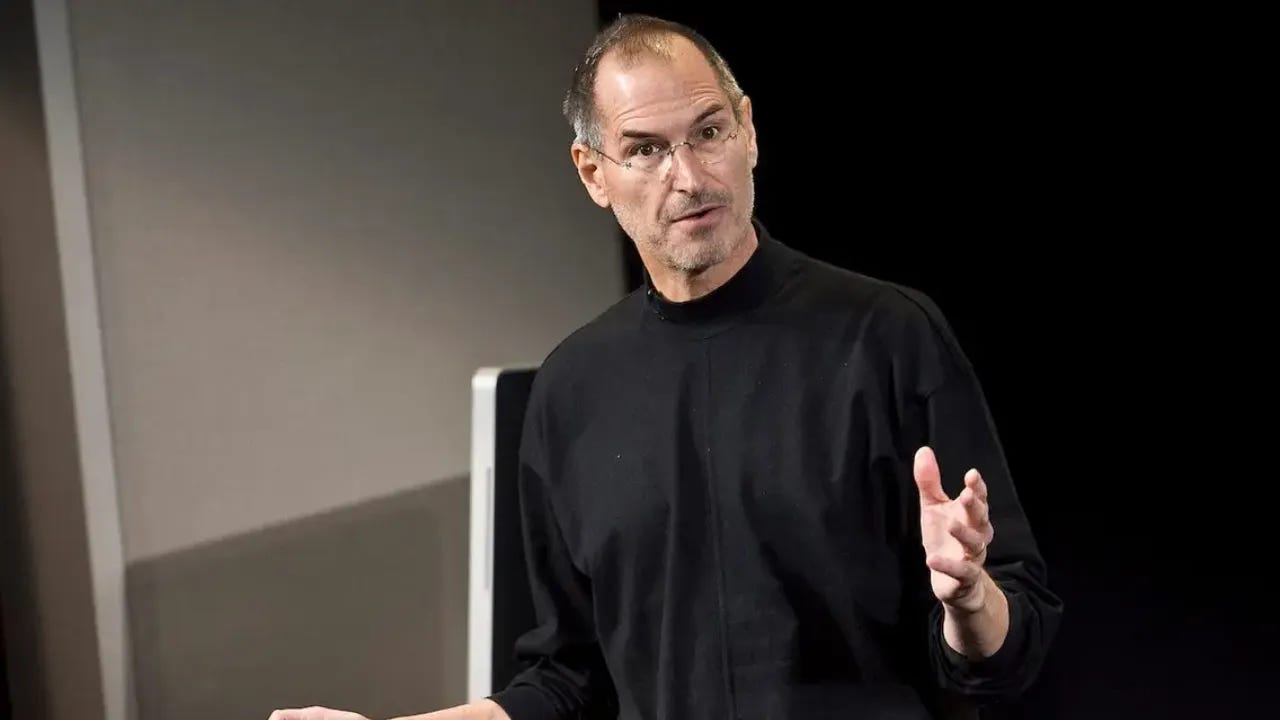
So for this CPO it was the same thing Jobs did and getting the opposite result, because she did the thinking rather than the copying. The rotation, the block colours and the five-minute face all exist so that what she is wearing stops being a live question before she has left the house, which matters more when you are a mother of a six-year-old and the mornings are already full.
The most useful thing you can wear is the thing that lets you stop thinking about what you are wearing.
What actually moved her career
There is a second thread running underneath all of this, and it took me a while to see the connection.
The CPO has had very few job interviews. Her career moved through hallways. A managing director noticed she had a head for numbers and asked her to pick a superannuation fund for the consultants, and that turned into a finance career. She told a team leader she was interested in her team and a role appeared the following week. She met a man in a corridor and he said come and work for me. The role she holds now came from someone who had watched her work and told her there were good problems to solve.
Careers do not move like that for people the room has only ever met a toned down version of. They move like that for people who are clear enough that somebody can describe them accurately in a meeting they are not sitting in.
That is the argument in one line. Advocacy happens in your absence, and what gets advocated is whichever version of you the room has actually met.
She put it herself, and she seemed almost surprised to hear it out loud: she has reached this level of leadership without ever changing who she is. I told her at the time that I was stunned, and I meant it, because very few women get to finish that sentence. She talks about the things other people leave alone, she takes the alternate view in the room, and she has been promoted the whole way for a version of herself she recognises.
She also said that early on she assumed she would never be able to play in that world at all. She looked at the matrix of middle management and senior management with the CEO somewhere at the top, appearing at town halls, and could not see where someone like her would fit. What happened instead is that she stayed close enough to herself to be findable, and the people who worked the same way found her.
What this leaves us with
The calculation is real. as a high performing CPO and mum she runs it, I run it, and every woman reading this is running some version of it before a board paper, a keynote, a client pitch or an ordinary Monday.
The change here is not refusing to run it, because refusing does not stop the room from forming a view, it only means you are now carrying the view and the argument about the view. The exit is answering it once, properly, at a level of detail that actually holds, so it stops taking a withdrawal every single morning. That is the part worth borrowing from her, and the dress is incidental to it.
So here is something to think about, what are you still deciding every morning that you could decide once, and never think about again?
Did you enjoy this?
If this landed, share it with someone who you know is ready to start owning and living their presence their way.
Love this. The cost is real, the solution is perfect but hard. Inspiring.